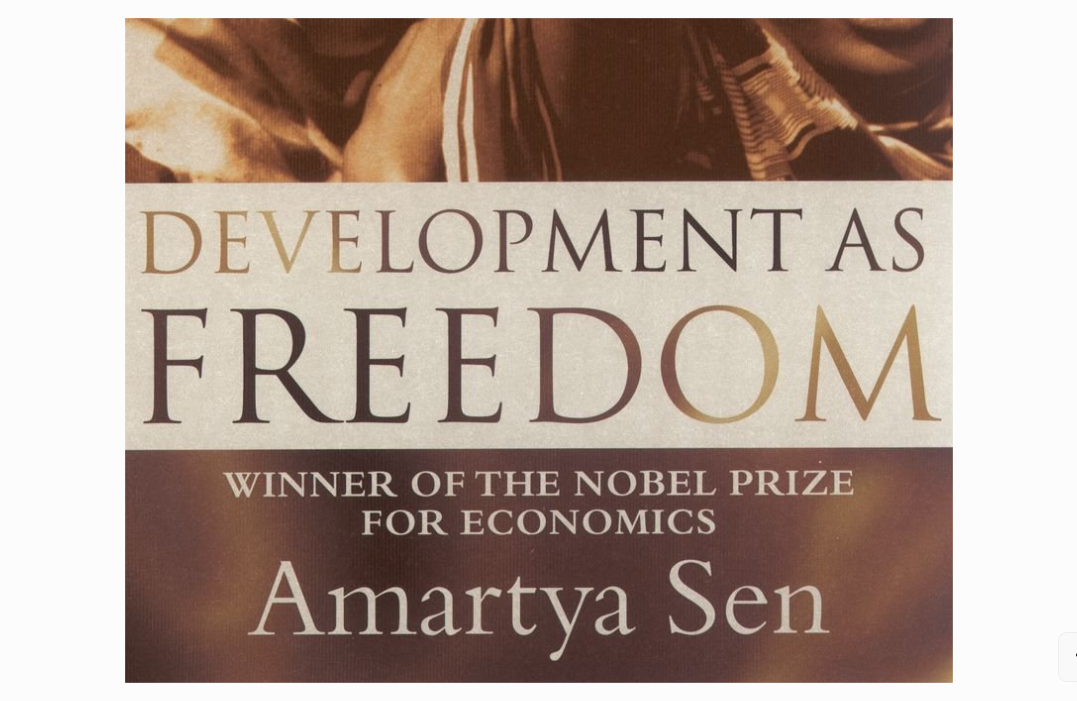
“We live in a world of unprecedented opulence, of a kind that would have been hard even to imagine a century or two ago. There have also been remarkable changes beyond the economic sphere. The twentieth century has established democratic and participatory governance as the preeminent model of political organization. Concepts of human rights and political liberty are now very much a part of the prevailing rhetoric. People live much longer, on the average, than ever before. Also, the different regions of the globe are now more closely linked than they have ever been. This is so not only in the fields of trade, commerce and communication, but also in terms of interactive ideas and ideals.
And yet we also live in a world with remarkable deprivation, destitution and oppression.There are many new problems as well as old ones, including persistence of poverty and unfulfilled elementary needs, occurrence of famines and widespread hunger, violation of elementary political freedoms as well as of basic liberties, extensive neglect of the interests and agency of women, and worsening threats to our environment and to the sustainability of our economic and social lives. Many of these deprivations can be observed, in one form or another, in rich countries as well as poor ones.
Overcoming these problems is a central part of the exercise of development.”
So begins Amartya Sen’s Development as Freedom.
If the aim is human flourishing, measuring income is not enough. Income is not capabilitity or freedom. And substantive freedoms of political, social and economic nature are basic conditions of development. This perhaps is the key argument of the book. This argument is built throughout the book through different lenses of development. It is something to be read again and again to absorb fully. The idea of this post is to note down some pointers and tangents inspired by the book.
*
The book is drawn from a series of lectures given by the author at World Bank in 1996. It is a foundational work, building on, synthesising and expanding the past approaches in the economics world. It deals with the new world, the new world of persistent inequalities, of growth on one end and continued oppression on the other. Although almost three decades old, the messages are timeless.
Amartya Sen was born in 1933 in Bengal, grew up through partition and the 1943 famine, studied in Calcutta and then Cambridge, taught in India before moving to Oxford, Harvard, and back to Cambridge. His lifelong work and thought on economic deprivation and social justice has been influenced by what he has seen, where he has grown up, and more than facts, runs like a closely lived experience and consciousness throughout the book.
A worldview is a way to organise the world, our innate desire to see the world in a way we can understand. His is a nuanced one, a seeing well, seeing far and wide, the worst and best of humanity, seeing the malnourished, the poor, the hungry and seeing the capabilities that they are deprived of. And his proposal is that of arguing for the freedoms and capabilities of the individual rather than just measuring the overall numbers and economic indicators of a people.
He stands, according to him, in a long tradition of development literature, beginning with perhaps Aristotle and his Nichomachean Ethics, William Petty (1691 – Political Arithmetick), Adam Smith, Karl Marx, John Stuart Mill, Friedrich Hayek. Each in their own way has emphasised the importance of freedom as a criterion for development.
Where the rich world has been preoccupied by the question of Welfare state and measuring it, this book presents a much richer, fuller argument in terms of freedom and unfreedom as experienced by an individual, both in the rich and poor world. And the activities of the state that can help expand these freedoms.These freedoms are social, political and economic. He argues that these substantive freedoms ‘constitute’ development. Effectively, the freedom of the individual to live long and live well. He prefers to measure development by that lens rather than the measures of GDP and other such metrics.
For example, the citizens of Gabon or South Africa or Namibia or Brazil may be much richer in
terms of per capita GNP than the citizens of Sri Lanka or China or the state of Kerala in India, but the latter have very substantially higher life expectancies than do the former.
It is through the exploration of such intergroup contrasts that the book draws its attention to its more expansive way of considering welfare, and rather, development. Further, the book explores “the roles and interconnections between certain crucial instrumental freedoms, including economic opportunities, political freedoms, social facilities, transparency guarantees, and protective security.”
As to why the difference in this analysis, compared to say per capita GNP – he mentions that freedom is concerned both with the processes of decision making as well as opportunities to achieve valued outcomes, while other measures often look only at the outcomes. They are not just the means of development but the ends as well. As to opportunities, they have to be viewed both for their intrinsic as well as derivative importance. And as he says
“income levels may often be inadequate guides to such important matters as the freedom to live long, or the ability to escape avoidable morbidity, or the opportunity to have worthwhile employment, or to live in peaceful and crime-free communities. These non-income variables point to opportunities that a person has excellent reasons to value and that are not strictly linked with economic prosperity.”
*
An illuminating and enriching read. It took me a while to work through it, but it leaves one so much richer in understanding the world better, our measures of it, and the importance of measuring the right thing. In his case, he puts the case to measure the freedoms and capability of individuals.
As to the interlinking of these freedoms: “Economic unfreedom can breed social unfreedom, just as social or political unfreedom can also foster economic unfreedom.”
Political freedoms (in the form of free speech and elections) help to promote economic security. Social opportunities (in the form of education and health facilities) facilitate economic participation. Economic facilities (in the form of opportunities for participation in trade and production) can help to generate personal abundance as well as public resources for social facilities. Freedoms of different kinds can strengthen one another.
A broad approach of this kind permits simultaneous appreciation of the vital roles, in the process of development, of many different institutions, including markets and market-related organizations, governments and local authorities, political parties and other civic institutions, educational arrangements and opportunities of open dialogue and debate (including the role of the media and other means of communication)
As to the role of democracy | Many things are wrong in the world, and they go wrong. The way the world is going, there are many such chances of things going wrong. When things are adverse, it is in such situations that the role of democracy is most acutely felt. One of Sen’s running arguments is about not a final list of normative measures to track but to keep that tension alive, with the democracy letting determine the range of capabilities that need to be measured. To have a range of economic, social, political and security capabilities available to the individual.
Regarding the important role of markets:
As Adam Smith noted, freedom of exchange and transaction is itself part and parcel of the basic liberties that people have reason to value. To be generically against markets would be almost as odd as being generically against conversations between people (even though some conversations are dearly foul and cause problems for others-or even for the conversationalists themselves). The freedom to exchange words, or goods, or gifts does not need defensive justification in terms of their favorable but distant effects; they are part of the way human beings in society live and interact with each other {unless stopped by regulation or fiat). The contribution of the market mechanism to economic growth is, of course, important, but this comes only after the direct significance of the freedom to interchange words,goods, gifts-has been acknowledged.
The importance of freedom of entering the labour market directly rather than bondage or slavery – part of the growth in developing countries is to free the labour from implicit or explicit bondage. Be it either market for labour or for production, a freedom of the individual to enter it freely.
He also places importance in the book on human capability, in context of human capital itself. “It can be said that the literature on human capital tends to concentrate on the agency of human beings in augmenting production possibilities. The perspective of human capability focuses, on the other hand, on the ability-the substantive freedom-of people to lead the lives they have reason to value and to enhance the real choices they have.” A person has capabilities, and freedom, and the value can be both direct (e.g. them being well nourished) or indirect (them aiding to more production – economic goal as well as other social change). Where human capital is concerned mainly with indirect values, the capability question takes into account both direct and indirect value. That is human beings are not just means of production but the eventual ends of the exercise.
He also talks about empowerment of women as generally improving the world around them:
Also, the empowerment of women, through employment opportunities, educational arrangements, property rights and so on, can give women more freedom to influence a variety of matters such as intrafamily division of health care, food and other commodities, and work arrangements as well as fertility rates, but the exercise of that enhanced freedom is ultimately a matter for the person herself. The fact that statistical predictions can often be plausibly made on the ways this freedom is likely to be used (for example, in predicting that female education and female employment opportunity would reduce fertility rates and the frequency of childbearing) does not negate the fact that it is the exercise of the women’s enhanced freedom that is being anticipated.
This is very much a book about yardsticks. What is measured, looked at, considered to assess development. In his view, it should be the freedoms of the people concerned, their actual abilities rather than just outcomes. If the focus is on people having the freedom to live lives they value, then a more foundational understanding of development as expansion of human capability and expansion of opportunities needs to be seen. And this distinction has significant bearing on public policy.
“It is a characteristic of freedom that it has diverse aspects that relate to a variety of activities and institutions. It cannot yield a view of development that translates readily into some simple “formula” of accumulation of capital, or opening up of markets, or having efficient economic planning (though each of these particular features fits into the broader picture). The organizing principle that places all the different bits and pieces into an integrated whole is the overarching concern with the process of enhancing individual freedoms and the social commitment to help to bring that about.”
*
One way to understand the world is through the economic history of its people. Different regimes, different ages, different economies. How misinformed the governments and policy makers have been at times. How they have reacted to the human misery in famines. We live in a later age, the age that can absorb the lessons of history, has widespread access to those lessons, principles, approaches, the pros and cons, and what to measure and why.
It is not just about that what is measured but the reference points and the texture of that what is measured as well. That those in the position of taking these policy calls need to have a rich understanding ot the texture of the world itself beyond what GDP measures can grant. The book, working through several examples makes you see the unrecorded world. Policy responds to what is measured, but if what that is measured is a flawed metric, if something more nuanced is being missed, then there is no policy priority for certain capability inequalities which might be a better, fuller way of considering inequality itself. What is measured in traditional way may not present the full picture. Sen proposes the capability point of view which allows nuance to enter the conversation.
On a personal note, I often wonder what life as another human being, any human being on this planet implies or means. One perhaps reads far and wide to try to appreciate that. It is a matter of chance and fate that one is born where one is, finds life as one does. That I am I and you are you, and the person struggling in Sundar Ban for his life to gather a dollar worth of honey is who he is and where he is. It is chance and if tables were turned, would the world still be fair and just? There are millions human beings still hungry, malnourished, without access to clean drinking water or proper sanitation, education and basic healthcare itself a far cry, with poor economic, social and political capabilities or access to opportunities to improve their lot.
But for it to be a world, which does right by you, a fair and just world, and not made worse because of human acts of not seeing well, or creating good policy which provides importance to individual freedom and capability, there is perhaps no final answer. Only the trying. Best efforts to provide a life of freedom, dignity to maximum number of people possible. Perhaps that is the objective function that a government maximises, and not just numeric quantifiable indicators of economic growth.
*
A tangent: SDGs
That leads us to SDGs. The Sustainable Development Goals build up on some of Amartya Sen’s work.
On SDGs themselves, the world has come far, there is a lot of development, food yields have improved, significant progress has been made on each goal, but the way population has increased, there is a great distance still to be covered to ensure substantive freedoms to a signifciant portion of the world. What one can perhaps see from the this post on inequality is that the margin of subsistence is very low in a big part of the world which makes people vulnerable to adverse events.
Perhaps when one considers growth, one has to consider is the growth wide and broad enough to cover the vast numbers struggling with the basic freedoms of life (economic, social, political, transparency and security). At many levels, the world is far from developed, and especially if one were to consider the substantive freedoms. Here are a few charts and statistics from the Sustainable Development Goals and Our World in Data which highlight how many, many go hungry, do not have access to water, food, sanitation, healthcare, education, jobs, clean cooking fuel (leading to diseases and high morbidity), and are out of any social safety nets or even political freedom. 
Consider the following charts from Our World in Data:
Goal 1 – No Poverty


Goal 2 – Zero Hunger


Goal 3 – Good Health and Well Being


Goal 4 – Quality Education

Goal 6 – Clean Water & Sanitation


Goal 7 – Affordable and Clean Energy


If interested further, here are a few links to explore:
- Here’s the SDG tracker by Our World in Data which shows the current state of the 17 Sustainable Development Goals.
- Sen’s Nobel Lecture, and
- AI companion to the book itself – by Claude. (AI can make errors so please refer accordingly)