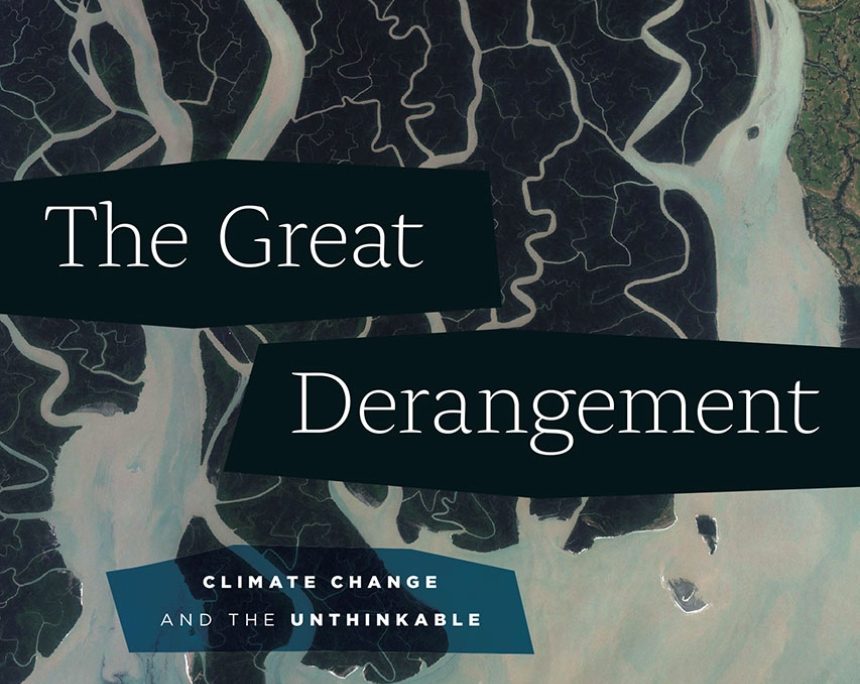

I recently read Amitav Ghosh’s ‘The Great Derangement’. The book is about climate and the way perhaps future generations will call this age of ours the greatly deranged age – these 300 years of industrialisation, consumption, exploitation of earth’s resources, and our persistent blind eye to what is happening to the world. Once read, the book compels one to reread it, write about it, and ask more people to read it. Eventually it is about awareness, understanding, appreciation. The more we all grasp the situation better, the better our collective decisions will be. This I hope and feel, hence this note.
First, lets consider some excerpts from the book:
‘While finitude characterizes all things under heaven, appetites alone know no bounds. When the amount of what is of finite supply is gauged on the basis of boundless appetites, the exhaustion of the former can be expected within a matter of days. Conversely, the depletion of finite things would soon come when used to satisfy insatiable desires.”
– Zhang Shizhao (1881–1973) who was minister of education in Duan Qirui’s government in China (as quoted by Amitav Ghosh)
“The humans of the future will surely understand, knowing what they presumably will know about the history of their forebears on earth, that only in one, very brief era, lasting less than three centuries, did a significant number of their kind believe that planets and asteroids are inert.”
“In a substantially altered world, when sea-level rise has swallowed the Sundarbans and made cities like Kolkata, New York and Bangkok uninhabitable, when readers and museumgoers turn to the art and literature of our time, will they not look, first, and most urgently, for traces and portents of the altered world of their inheritance? And when they fail to find them, what should they—what can they—do other than to conclude that ours was a time when most forms of art and literature were drawn into the modes of concealment that prevented people from recognizing the realities of their plight? Quite possibly then, this era, which so congratulates itself on its self-awareness, will come to be known as the time of the Great Derangement.”
The book is an outcome of a series of lectures delivered by the author (lectures available here) at University of Chicago, and reads like a long essay, an awareness explored and built over the pages. It works through many intertwined arguments about climate, modern consumerist society and the way of the world, which is clearly unsustainable. The book explores these through many lenses, the two significant ones being that of imperialism, colonialism and their fallouts, and the second of art and literature. Eventually this complex problem is seen through multiple angles: that of freedom, both economic and political; that of being on the wrong side of history; that “climate events of this era, are distillations of all of human history: they express the entirety of our being over time.”; that of the political economy of coal vs that of petroleum; that of Asia as the new reason and the largest victim; that of how art and literature could make sense of all this in deep thought which at the moment it is failing to do.
The book is divided across three sections. The first one titled Stories, where the world we find ourselves in today is laid bare through stories personal and public, from author’s own familial history, personal experience to that of the public experience of cities of Mumbai and other low lying areas affected by changing weathers, increasing cyclone activity, and other repurcussions on nature because of human activity. A snapshot of what is happening around the world – things that are being felt and experienced, yet and a big questionable yet, somehow art and literature are quiet about it.
There’s his approach to the issue, a question he wonders about why is climate change not much spoken about in fiction, and to answer that he delves into the form of narrative and novel which has evolved over time, and the seeming improbability of certain events make them difficult to approach in fiction which deals with ‘life as usual’, the modern day life.
“That climate change casts a much smaller shadow within the landscape of literary fiction than it does even in the public arena is not hard to establish.
Indeed, it could even be said that fiction that deals with climate change is almost by definition not of the kind that is taken seriously by serious literary journals: the mere mention of the subject is often enough to relegate a novel or a short story to the genre of science fiction. It is as though in the literary imagination climate change were somehow akin to extraterrestrials or interplanetary travel.
But the truth, as is now widely acknowledged, is that we have entered a time when the wild has become the norm: if certain literary forms are unable to negotiate these torrents, then they will have failed—and their failures will have to be counted as an aspect of the broader imaginative and cultural failure that lies at the heart of the climate crisis.”
The second section talks about the history of this derangement. Here is explored in detail the impact of imperialism, colonialism and the modern western progress model world of ours. He also notes that the cities of Mumbai, New York, Boston and Kolkata were all brought into being through early globalization. And today, these cities are threatened with destruction. How is one to take different decisions or change the patterns of growth and development “In a world where the rewards of a carbon-intensive economy are regarded as wealth”?
“Every family in the world cannot have two cars, a washing machine and a refrigerator—not because of technical or economic limitations but because humanity would asphyxiate in the process.”
“It is Asia, then, that has torn the mask from the phantom that lured it on to the stage of the Great Derangement, but only to recoil in horror at its own handiwork; its shock is such that it dare not even name what it has beheld—for having entered this stage, it is trapped, like everyone else. All it can say to the chorus that is waiting to receive it is ‘But you promised . . . and we believed you! In this role as horror-struck simpleton, Asia has also laid bare, through its own silence, the silences that are now ever more plainly evident at the heart of global systems of governance.”
Leading us into the third section about the politics of it all. Perhaps the author’s words are best to take us through the political repurcssions of imperialism, of the petrol economy (vs that of coal) which changed the power equations across the world between labour and capital, and to the role of Anglosphere in considering the current issue and its new political role.
“What determined the shape of the global carbon economy was that the major European powers had already established a strong (but by no means hegemonic) military and political presence in much of Asia and Africa at the time when the technology of steam was in its nascency, that is to say, the late eighteenth and early nineteenth centuries. From that point on carbon-intensive technologies were to have the effect of continually reinforcing Western power with the result that other variants of modernity came to be suppressed, incorporated and appropriated into what is now a single, dominant model.”
“As an instrument of disempowerment oil has been spectacularly effective in removing the levers of power from the reach of the populace. ‘No matter how many people take to the streets in massive marches,’ writes Roy Scranton, ‘they cannot put their hands on the real flows of power because they do not help to produce it. They only consume.”
This altered political reality may in part be an effect of the dominance of petroleum in the world economy. As Timothy Mitchell has shown, the flow of oil is radically unlike the movement of coal. The nature of coal, as a material, is such that its transportation creates multiple choke points where organized labour can exert pressure on corporations and the state. This is not the case with oil, which flows through pipelines that can bypass concentrations of labour. This was exactly why British and American political elites began to encourage“the use of oil over coal after the First World War.””
“The enmeshment of global warming with issues of an entirely different order has given a distinctive turn to the politics of climate change in the Anglosphere. Instead of being seen as a phenomenon that requires a practical response, as it largely is in Holland and Denmark, or as an existential danger, as it is in the Maldives and Bangladesh, it has become one of many issues that are clustered along a fault line of extreme political polarization.”
But most of all, the author talks about how the performance part of politics is getting far removed from the policy and action part. He nudges us towards reading Pope Francis’s Laudato Si, which according to him addresses the problem head on and more realistically than the negotiations for Paris Accord did.
Eventually it is a problem, a catastrophe, in which the human way of being itself needs to be addressed and reconsidered. And the issue is complex with factors of freedom, morality, existential issues, future generations, imperliast history and the Western way of living. It is about bridging the gap between desire/appreciation and political action which is getting further apart in today’s world according to the author. But it is not just about the political, it is about the world of art and literature too to offer imaginative considered solutions and aspects, to explore the issues in a nuanced way which only art & literature with its deep insights can do.
“Climate change is often described as a ‘wicked problem’. One of its wickedest aspects is that it may require us to abandon some of our most treasured ideas about political virtue: for example, ‘be the change you want to see’. What we need instead is to find a way out of the individualizing imaginary in which we are trapped.
When future generations look back upon the Great Derangement they will certainly blame the leaders and politicians of this time for their failure to address the climate crisis. But they may well hold artists and writers equally culpable—for the imagining of possibilities is not, after all, the job of politicians and bureaucrats.”
As to how art and literature encompasses, absorbs and responds to the calamity that seems to currently go unrecorded in the deep psyche, to that one of the places I came across as possible response to this of Ghosh’s lament about in art and literature, is in Christopher Hitchens, in his Unacknowledged Legislation, about the power of language and poetry:
“What might now be the tasks, or the opportunities, for the latent political intelligence of literature? The first, I suggest, is to find a language that can match the new world, or new cosmos, created for us by the Hubble telescope and the translation of DNA. We live at the opening of an age where the nature of humanity, and the nature of the universe, can at last be scrutinised and understood without racism or tribalism, and without superstition. (A page of Stephen Hawking on the ‘event horizon’ is more awe-inspiring than anything in Genesis or Ezekiel.) But we still employ the stilted and faltering metaphors of our pre-history; translating vivid new discourses back into the safe, solipsistic patois that we already know.” – Chritsopher Hitchens
Some personal thoughts
There are cycles in the world, of which the clock is a miniature way to look at, seconds, minutes, hours, each circling the centre at a different pace. But in nature, umpteen cycles keep moving. Nothing is still, everything is slowly or rapidly churning. Some of these are discernible to us like seconds and minutes and some of these are in rhythm with our being like hours, days, months and years. But many of these, because they are beyond our easy discernment, sometimes are not really grasped, understood, or their magnitude and impact appreciated. One gets a feeling reading this book that so much of the world is beyond our time-sense-grasp, that where one should listen to or bow to the wisdom of ages, just because one cannot discern or see so far. Either we need the wisdom of ages, but to deal with something new, we need imaginative new solutions too which are offshoots of respect, rather than the blatant disregard and indifference at the moment. The current pace of life, the practicality of living and at a level, it is some sort of fear of missing out that drives the human race so competitively, capitalistically forward.
“Money flows toward short term gain,’ writes the geologist David Archer, ‘and toward the over-exploitation of unregulated common resources. These tendencies are like the invisible hand of fate, guiding the hero in a Greek tragedy toward his inevitable doom.’ This is indeed the essence of humanity’s present derangement.”
Personally, I don’t know how one breaks the tide of the way humanity has chosen progress and materialism and capitalism and the race to resources, without really building in the right price of things. Air and water being the most basic, and the only renewable resources we have, can be addressed by building in the price of cleaning them in the price of consumption. Earth regenerates, and both air and water can be regenerated if we would only help the process and actually allow the cost to be built in to the cost of things. As to the rest of the extraction of earth from minerals to fossil fuels, unless we change our value matrix, our way of living, or use our collective brains to develop the world on a more sustainable, long-term basis, how is true economic freedom which respects the primary value of currently threatened life to be found? At the moment, only the cost of extraction is referred to, and the cost of replacement is completely ignored. The right price will perhaps slowly nudge us into the right habits.
If not, then what is happening is what people from Gass to Gandhi allude to, the human appetite is like that of locusts, – ‘a universe is on fire’, but because this fire is not felt acutely immediate, the brain relegates the fire as invisible. Some of these things are as much about real awareness, mindshare, thoughtshare of more and more people – both young and old. The world turns itself over fairly quickly in the timescale of history, but the impact of these few scores of generations of human beings will be felt for a long long while. And I don’t know the solution but I think that the more we all know appreciate understand and talk about it, the better collective decisions we’ll take for the planet and the humanity or generations yet to enjoy the planet.
As to the role of art and literature, the author opens up the age old argument about the role of art and literature in life itself, and it is something any reader or audience of good art would agree to perhaps. I also believe that art allows the complexity to seep into the subconscious while taking the conscious mind through the pleasures of narrative. Hence perhaps the author’s behest at literature’s role in dealing with the complex place we find the world in. And until some problems are thought deeply about, and non-obvious imaginative solutions allowed to surface, it is difficult to stem this tide of Westernised unsustainable progress that the world finds itself in.