(Numbers are for directional reference only. Data and charts from various sources on the internet)
Coal is a fossil fuel formed by the combined effect of pressure and heat on the vegetation of over 200-350 million years ago. It has been mined for thousands of years in shallow surface mines around the world, but in true earnest, its mining evolved when the forces of technology and transport converged as demand. That being a couple of centuries ago. Since coal, or for that matter other fossil fuels cannot be replaced for millions of years, the kind of usage and mining that this period (last couple of centuries) has seen and our current century witnesses is a one-off in earth’s history and near-term future. No wonder Amitav Ghosh refers to this period as that of The Great Derangement.
Volume of consumption
Just to get a sense of how this mining and demand continues to grow, in the year 1900, global coal consumption was around 480 million tonnes of oil equivalent (Mtoe), making it the dominant energy source (of total energy of 1092 Mtoe). In 2025, global coal consumption was around 8.85 billion tonnes or 6,300 Mtoe (coal is still a quarter of world’s primary energy supply). And 2025 was a record high year of coal demand.
Largest Consumers
Of all the nations consuming coal, China alone surpasses the consumption of rest of the world combined. In terms of reserves though, world coal reserves are around ~1 trillion tonnes (annual consumption ~9 billion tonnes), with a quarter of these reserves in the US, followed by Australia, Russia, China, India.

To note here the growth in production and consumption in this century itself in China. This was not so before. See the chart below.
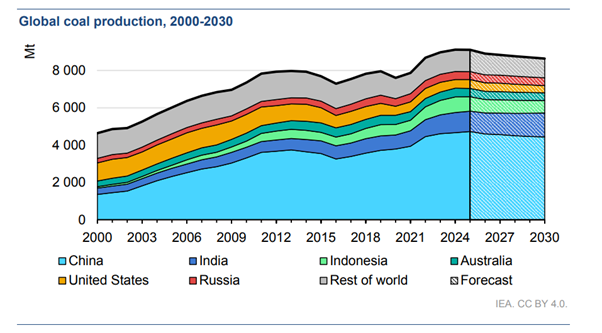
Coal has powered China over the last few decades.
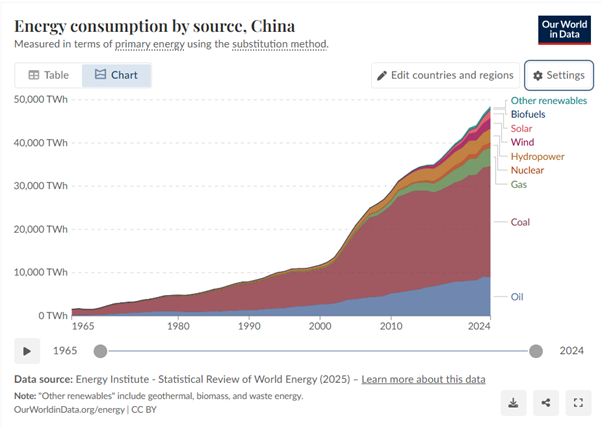
Compare it to another country, say USA. Where China is the largest consumer of coal in the world, US is the largest consumer of oil in the world.

Key uses of Coal
The primary uses of coal is for energy production. Where fossil fuels today globally account for ~60% of electricity generation, coal accounts for 35% of total global power generation. (and a quarter of world’s primary energy supply)
Globally, 65% of coal is used for power generation. The rest is used by industry and other sectors including chemicals etc. It is one of the critical input in steel production.
One of the most interesting uses is for liquifying it to replace it for oil and gas. ” In China, the sector last year(2024) turned 276 million tons of coal – equivalent to almost a year of European coal use – into chemicals, oil and gas”
Coal conversion in China refers to the transformation of coal into other products through processes such as gasification and liquefaction. The main routes include: coal-to-liquids, which produces fuels like diesel and gasoline either through direct hydrogenation or indirectly via synthesis gas and the Fischer-Tropsch process; gas works, which generate synthetic natural gas and fertilisers using coal-derived synthesis gas; and coal-to-chemicals, which converts coal into synthesis gas for products such as methanol and ethylene glycol. These technologies have historically been pursued to reduce reliance on oil and gas – mostly imported…
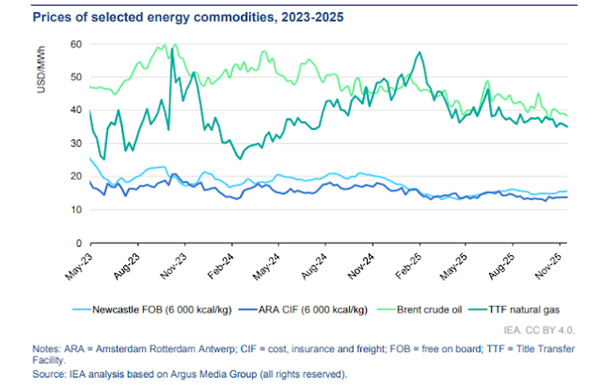
Perhaps this chart showing price difference will illuminate the reason coal still persists. (Newcastle and ARA prices refer to coal).
Trade in Coal
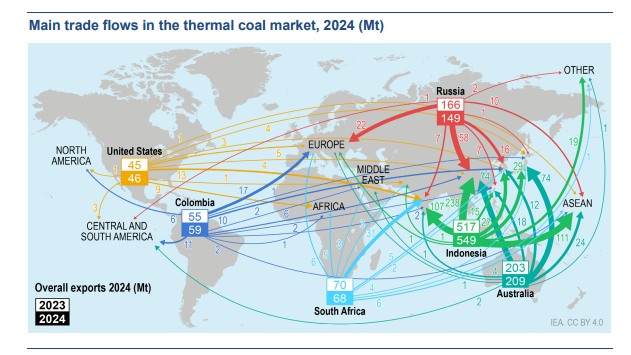
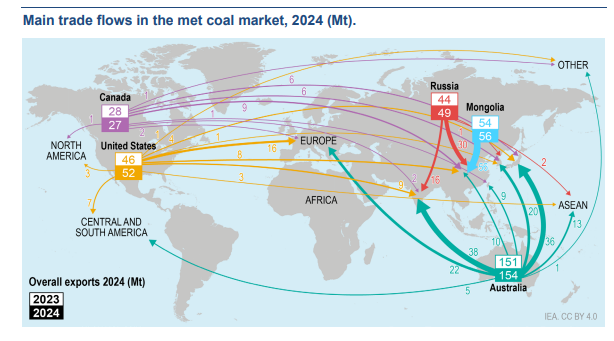
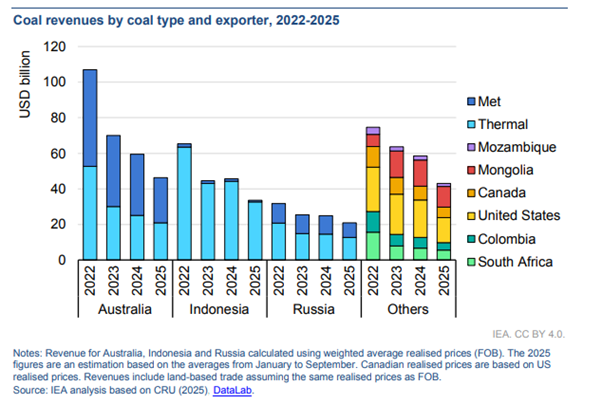
Most producers of coal are large consumers of coal. Still, coal trade is 18% of the global coal demand. Of this, thermal coal makes up over 75% of total traded volume. The key countries are Australia, Indonesia and Russia.
Here are a few charts, two of them showing the trade, and the other the value received by key countries. Volume wise Indonesia is the largest exporter, value wise it is Australia given the high quality metallurgical coal found here.