Leverage Points
A post to note this popular essay/chapter on ‘Leverage Points: Places to Intervene in a System’ drawn from Donella H. Meadows’ ‘Thinking in Systems – A Primer’.
The advent of systems view of things has updated our understanding of the way many things in this world behave. There is no simple chain of cause and effect then that can explain the way things behave. So be it a human body, a company or an economy, the way to think about things is the way of systems, which may not be straightforward logic, may seem counterintuitive, but by seeing these things as complex systems, and working with them accordingly, we can find better outcomes.
“So, what is a system? A system is a set of things—people, cells, molecules, or whatever—interconnected in such a way that they produce their own pattern of behavior over time. The system may be buffeted, constricted, triggered, or driven by outside forces. But the system’s response to these forces is characteristic of itself, and that response is seldom simple in the real world.
Once we see the relationship between structure and behavior, we can begin to understand how systems work, what makes them produce poor results, and how to shift them into better behavior patterns. As our world continues to change rapidly and become more complex, systems thinking will help us manage, adapt, and see the wide range of choices we have before us. It is a way of thinking that gives us the freedom to identify root causes of problems and see new opportunities.”
As to where in the systems can one intervene with maximum effectiveness, she suggests certain places where a small change can produce big change. The author calls them Leverage Points.
“Leverage points are places within a complex system (a corporation, an economy, a living body, a city, an ecosystem) where a small shift in one thing can produce big changes in everything.”
As Meadows notes, “Leverage Points are points of power.” They can be counterintuitive.
“Counterintuitive—that’s Forrester’s word to describe complex systems. Leverage points frequently are not intuitive. Or if they are, we too often use them backward, systematically worsening whatever problems we are trying to solve.”
As to why they are not intuitive, perhaps worth looking at the following example. Meadows begins by explaining a simple system of a bathtub and the desire for a particular temperature of water. There are mechanisms like inflow and outflow, and feedback loops that affect the state of the system. But that is one tub.
“As systems become complex, their behavior can become surprising. Think about your checking account. You write checks and make deposits. A little interest keeps flowing in (if you have a large enough balance) and bank fees flow out even if you have no money in the account, thereby creating an accumulation of debt. Now attach your account to a thousand others and let the bank create loans as a function of your combined and fluctuating deposits, link a thousand of those banks into a federal reserve system—and you begin to see how simple stocks and flows, plumbed together, create systems way too complicated and dynamically complex to figure out easily.”
Following are the 12 places from the linked essay (which I suggest you read in its short entirety for the many examples that make the arguments clear), where one may intervene in a system in increasing order of effectiveness. Although she calls it a work in progress, it is an invitation to think about systems and the effect of intervention in a more nuanced way. Anyone, be it a person wondering about the complex system of human body, to someone running a company or running or thinking about an economy can benefit from this viewpoint into systems and the points of power.
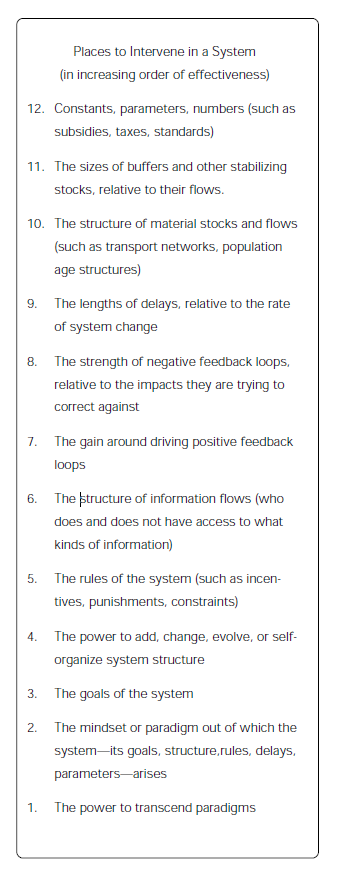
12. Numbers—Constants and parameters such as subsidies, taxes, standards
Often believed to be the key and most attended to, also some of the more popular intervention points, according to Meadows, parameters are the least effective places to intervene in a system. It is like putting a different hand on the faucet in the above tub example. Although people care deeply about parameters, they rarely change behavior. “If the system if chronically stagnant, parameter changes rarely start it.” So in most ranges in a system, parameters are not leverage points, until they kick off one of the items later on the list.
11. Buffers—The sizes of stabilizing stocks relative to their flows
“In chemistry and other fields, a big, stabilizing stock is known as a buffer.” Stocks that are big, relative to their own flows, are more stable than small ones. And often systems are stabilised by increasing the buffer. And there’s leverage point in that, but buffers being physical entities are not easy to be changed, hence regarded as less effective.
10. Stock-and-Flow Structures—Physical systems and their nodes of intersection
The only way to fix a system that is laid out wrong is to rebuild it, if you can. But most of the times, systems are given, and unchangeable. Hence, these physical systems are low leverage points. “Physical structure is crucial in a system, but is rarely a leverage point, because changing it is rarely quick or simple. The leverage point is in proper design in the first place. After the structure is built, the leverage is in understanding its limitations and bottlenecks, using it with maximum efficiency, and refraining from fluctuations or expansions that strain its capacity.”
9. Delays—The lengths of time relative to the rates of system changes
A system just can’t respond to short-term changes when it has long-term delays. Delay length should be a high leverage point if the delay length can be changeable, but often it is not. It is the delay inherent in feedback loops that are the common cause of oscillations. “If you’re trying to adjust a stock (your store inventory) to meet your goal, but you receive only delayed information about what the state of the stock is, you will overshoot and undershoot.” As to its counterintuitive nature, consider this:
And that’s why slowing economic growth is a greater leverage point in Forrester’s World model than faster technological development or freer market prices. Those are attempts to speed up the rate of adjustment. But the world’s physical capital stock, its factories and boilers, the concrete manifestations of its working technologies, can change only so fast, even in the face of new prices or new ideas—and prices and ideas don’t change instantly either, not through a whole global culture. There’s more leverage in slowing the system down so technologies and prices can keep up with it, than there is in wishing the delays would go away.
The above four pointers related mostly to physical part of the system, that are difficult to change. Now the information and control parts, where more leverage can be found.
8. Negative Feedback Loops—The strength of the feedbacks relative to the impacts they are trying to correct
Negative feedback loops allow for systems to self-correct under different conditions. They are present in nature, and are brought in as controls in a system. They may not be very visible but their presence affects the long term welfare of the system. “The strength of a balancing loop—its ability to keep its appointed stock at or near its goal—depends on the combination of all its parameters and links—the accuracy and rapidity of monitoring, the quickness and power of response, the directness and size of corrective flows. Sometimes there are leverage points here.” And here is present the key information, ‘price’ of a thing, a signal to the market often intervened with in the wrong manner. Democracy is a feedback loop and it is weakened by many new factors. If the correcting impact has to increase in strength, the feedback loops need to be strengthened as well.
Examples of strengthening balancing feedback controls to improve a system’s self-correcting abilities include:
• preventive medicine, exercise, and good nutrition to bolster the body’s ability to fight disease,
• integrated pest management to encourage natural predators of crop pests,
• the Freedom of Information Act to reduce government secrecy,
• monitoring systems to report on environmental damage,
• protection for whistleblowers, and
• impact fees, pollution taxes, and performance bonds to recapture the externalized public costs of private benefits.
7. Positive Feedback Loops—The strength of the gain of driving loops
A negative feedback loop is self-correcting. A positive feedback loop is self-reinforcing. The more it works, the more it gains the power to work some more. But unchecked positive loops can ultimately destroy the system. “Reducing the gain around a positive reinforcing loop—slowing the growth—is usually a more powerful leverage point in systems than strengthening negative loops, and much preferable than letting the positive loop run.”
the “success to the successful” trap. Rich people collect interest; poor people pay it. Rich people pay accountants and lean on politicians to reduce their taxes; poor people can’t. Rich people give their kids inheritances and good educations. Antipoverty programs are weak negative loops that try to counter these strong positive ones. It would be much more effective to weaken the positive loops. That’s what progressive income tax, inheritance tax, and universal high-quality public education programs are meant to do.
Control must involve slowing down the positive feedback. In ordinary systems, they can be found in places where the more you have of something, the more you have the possibility of having more. For instance, birth rates, interest rates, erosion rates.
6. Information Flows—The structure of who does and does not have access to information
According to Meadows, missing feedback is one of the most common causes of system malfunction. There are many examples she refers to in this point of leverage. By introducing a new information structure in a system, you can introduce a new loop (and it is not a parameter adjustment, not a strengthening or weakening of existing loop). It delivers information to a place where it was not going and causing people to behave differently. For instance, frequently visible electricity meters, water price that rises steeply as pumping rate exceeds recharge rate, reporting on emissions.
“There is a systematic tendency on the part of human beings to avoid accountability for their own decisions. That’s why there are so many missing feedback loops—and why this kind of leverage point is so often popular with the masses, unpopular with the powers that be, and effective, if you can get the powers that be to permit it to happen (or go around them and make it happen anyway).”
5. The Rules of the System —Incentives, punishments, constraints
“The rules of the system define its scope, its boundaries, its degrees of freedom.” Rules are high leverage points. Power over rules is real power. Changing rules changes the flows in the system itself.
Usually they are not changed that frequently, but
“If you want to understand the deepest malfunctions of systems, pay attention to the rules and to who has power over them.”
This is an important point in the current world (the conflict), and the rules it wishes to redraw.
4. Self-Organization—The power to add, change, or evolve system structure
“The ability to self-organize is the strongest form of system resilience. A system that can evolve can survive almost any change, by changing itself.” Mostly found in nature, from human immune system to human brain to DNA, self-organization is basically the combination of an evolutionary raw material (stock of information from which to select patterns) and a means of experimentation (for selecting and testing new patterns). In other systems, they can be considered as innovation. Something that comes from apparently nowhere, costing nothing, yet adds to the system, say increasing its productivity, almost miraculously.
“Further investigation of self-organizing systems reveals that the divine creator, if there is one, does not have to produce evolutionary miracles. He, she, or it just has to write marvelously clever rules for self-organization. These rules basically govern how, where, and what the system can add onto or subtract from itself under what conditions. As hundreds of self-organizing computer models have demonstrated, complex and delightful patterns can evolve from quite simple sets of rules.”
It also has nuance in the diversity of cultures, experimentation and innovation. “Insistence on a single culture shuts down learning. Cuts back resilience.” The system shouldn’t become so encrusted that it cannot self-evolve.
3. Goals—The purpose or function of the system
Everything in the system (physical stocks and flows, feedback loops, information flows, and even self-organizing behavior) gets twisted to conform to its goals. “What is the point of the game?” is to be answered to understand whole system goals.
The goal of keeping the market competitive has to trump the goal of each individual corporation to eliminate its competitors, just as in ecosystems, the goal of keeping populations in balance and evolving has to trump the goal of each population to reproduce without limit.
She also mentions here an exception to the hand on faucet lever – “The exception to that rule is at the top, where a single player can have the power to change the system’s goal.” She gives the example of Reagan in America, and how he “is testimony to the high leverage of articulating, meaning, repeating, standing up for, insisting upon, new system goals.”
2. Paradigms—The mind-set out of which the system—its goals, structure, rules, delays, parameters—arises
This is one of the highest power points in a system. Paradigms are the sources of systems. And here we are in the territory of implicit world-views. As to how one even approaches changing something like that:
You keep pointing at the anomalies and failures in the old paradigm. You keep speaking and acting, loudly and with assurance, from the new one. You insert people with the new paradigm in places of public visibility and power. You don’t waste time with reactionaries; rather, you work with active change agents and with the vast middle ground of people who are open-minded.
Systems modelers say that we change paradigms by building a model of the system, which takes us outside the system and forces us to see it whole.
“people who have managed to intervene in systems at the level of paradigm have hit a leverage point that totally transforms systems.”
1. The Power to Transcend Paradigms
It is in this space of mastery over paradigms that people throw off addictions, live in constant joy, bring down empires, get locked up or burned at the stake or crucified or shot, and have impacts that last for millennia.
This is the highest leverage. Gets into spiritual territory, not just changing world-views but questioning a world-view in an existential manner.
As she eventually notes, “The higher the leverage point, the more the system will resist changing it.”
Magical leverage points are not easily accessible, even if we know where they are and which direction to push on them. There are no cheap tickets to mastery. You have to work hard at it, whether that means rigorously analyzing a system or rigorously casting off your own paradigms and throwing yourself into the humility of not-knowing. In the end, it seems that mastery has less to do with pushing leverage points than it does with strategically, profoundly, madly, letting go and dancing with the system.
By considering the several leverage points in a system, it forces us to better understand and appreciate a system, its stocks and flows, its loops and information, its goals and rules, its key paradigms. My personal takeaway is that systems thinking is important and urgent for leaders if one has to pursue sustainable development of the world. Be it from effect of human actions on climate to ensuring the development of the population itself, a balance is to be found through appreciating the entire world as a system – an interrelated system.
The approach has wide application. From considering the modern changing world, to perhaps one can consider the works of economists such as Amartya Sen’s Development as Freedom in terms of changes to the system. And things like improving the quality of our living environment, be it cleaner water or cleaner air. Additionally, what even Ghosh suggests in his book can be further considered through the systems lens.

Understanding Healthcare
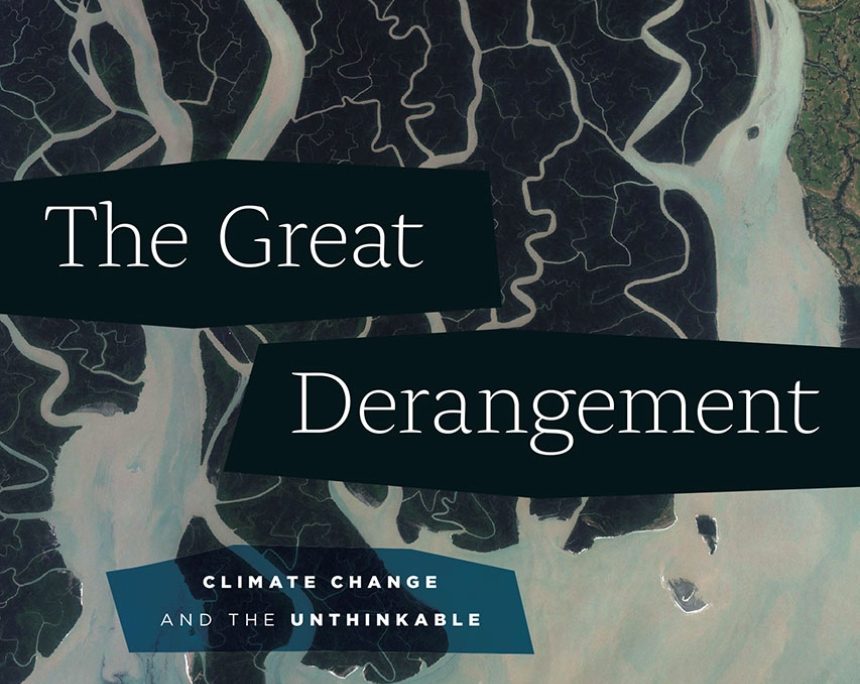
Amitav Ghosh’s ‘The Great Derangement’
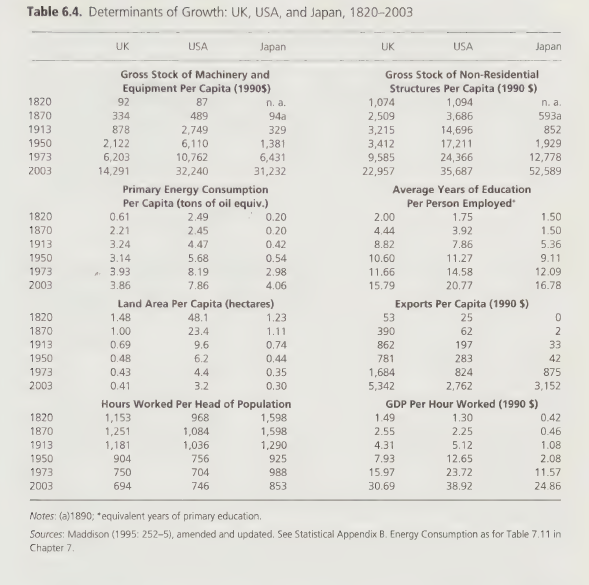
Two centuries of growth in one table | a story in numbers
About The Author
